

Quick Summary
Cost per load is the total you spend to wash and dry one load of laundry, including electricity, water, detergent and, optionally, the value of your time. To work it out, add up your machine's electricity use, your water use and your detergent cost per load, then compare that figure with a laundromat's price.
- Electricity cost per load equals machine power in kW, times cycle hours, times your rate per kWh.
- Water cost per load equals litres used divided by 1,000, times your rate per kilolitre.
- Use the usage rate on your bill, not the daily supply charge, when calculating per-load costs.
- Hot washes can cost noticeably more than cold washes on the same machine.
- A tumble dryer often costs more per load than the washer, so drying on a line can cut costs.
Table of Contents
- Why Cost Per Load Is the Number to Track
- Step 1: Gather Your Appliance and Bill Details
- Step 2: Calculate Electricity and Water Per Wash
- Step 3: Add Detergent, Dryer Use and Wear
- Laundromat vs Home Laundry Cost Comparison
- How to Save Money on Laundry in Australia
- Finding a Self-Service Laundromat Near You
- Frequently Asked Questions
How to Calculate Laundry Cost Per Load at Home
Last Updated: November 15, 2026
Most people never work out what a load of washing actually costs them. Yet with several loads a week, the bill adds up quickly. Spakleen Laundry, which runs self-service laundromats in St Kilda and Werribee, put together this guide so you can work out your own cost per load and compare it fairly with a laundromat. The main idea is simple: cost per load is the number to track, because it lets you compare a home machine with a self-service one on the same terms.
Why Cost Per Load Is the Number to Track
Cost per load is the total amount you spend to wash and dry one load of laundry. It includes electricity, water, detergent and, if you count it, the value of your time.
Most households perform between 5 and 8 loads of laundry per week, according to Texas Power Cost household laundry frequency benchmarks. That means a small difference per load becomes a large difference over a year.
Tracking cost per load helps you:
- See the real price of each wash, not just a guess
- Compare a home machine with a laundromat on equal terms
- Spot which loads cost the most, such as large doonas
The number also shows where your money goes. Once you know the cost per load, you can change how you wash and see the saving.
Step 1: Gather Your Appliance and Bill Details
Before you do any sums, collect a few numbers. You will need:
- Your machine's rated power use, found on the energy label or the manual
- Your electricity rate, in cents per kilowatt-hour (kWh), from your bill
- Your water rate, in dollars per kilolitre, from your water bill
- Your loads per week, counted over a normal fortnight
- Your detergent cost, from the price you pay per bottle or box
Keep the bill nearby. Your rates are on it, and they change over time, so use the current figures rather than old ones.
Reading a Victorian electricity bill correctly
Most Victorian households are on a market offer with a single flat rate, a time-of-use (TOU) rate, or a flexible tariff with a controlled load for hot water. The number you want is the usage rate in cents per kWh including GST, not the daily supply charge. The supply charge is a fixed cost you pay whether you wash or not, so it does not change the cost of an extra load.
If you are in the Werribee area, your electricity distributor is likely Powercor and your water retailer is Greater Western Water; in St Kilda, the water retailer is usually Yarra Valley Water and the distributor is United Energy or CitiPower depending on the street. You do not need to name them to do the maths, but knowing which bill line is the usage rate stops you grabbing the wrong figure.
Reading a water bill correctly
Water bills in Victoria show a usage rate in dollars per kilolitre (kL), plus a fixed service charge. One kilolitre is 1,000 litres, so a single load is a small fraction of a kilolitre. Use the usage rate, not the total bill divided by litres, because the service charge is fixed.
Why appliance age changes the inputs
Older machines can use noticeably more water and electricity per cycle than newer high-efficiency models. The energy label gives you the rated figure for a standard cycle, but an older machine drifts from that rating as seals, bearings and heating elements wear. If your machine is more than about eight years old, treat the label figure as a floor rather than a precise number, and add a maintenance allowance in Step 3. A common pattern is that the older the machine, the more the per-load cost is driven by water and heating rather than by detergent.
Watch out: do not use the daily supply charge or the total quarterly bill as your per-kWh rate, that will overstate the cost of every load and make a laundromat look cheaper than it is.
Step 2: Calculate Electricity and Water Per Wash
Electricity is usually the biggest direct cost of a home wash. Use this simple formula:
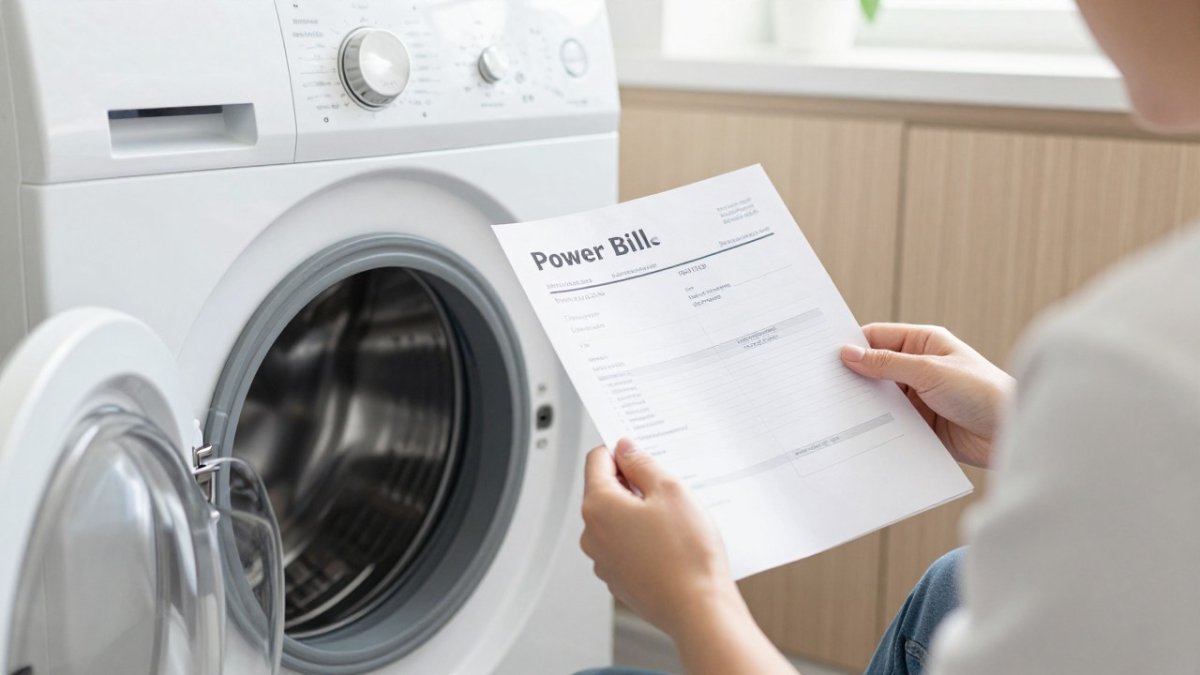
Electricity cost per load = Machine power (kW) × Cycle time (hours) × Your rate per kWh
For example, a 0.5 kW washer running a one-hour cycle uses 0.5 kWh. At a flat rate of 30 cents per kWh, that is 15 cents per load. If your plan charges 45 cents per kWh at peak and 20 cents per kWh off-peak, the same load costs about 22.5 cents at peak and 10 cents off-peak, which is why running a wash overnight on a TOU tariff can roughly halve the electricity component.
Water works the same way:
Water cost per load = Litres used per load ÷ 1,000 × Your rate per kilolitre
Water use per cycle varies by machine, so check your own model. At a water usage rate of, say, $3.00 per kilolitre, a 50-litre wash costs about 15 cents. Older top-loaders can use 100 litres or more, which doubles that figure.
A worked example you can copy
Take a household in Werribee doing 7 loads a week on a 0.5 kW front-loader with a one-hour cycle, a flat electricity rate of 30 c/kWh, a water rate of $3.00/kL and 50 litres per wash:
- Electricity: 0.5 kWh × 30c = 15c per load
- Water: 50 L ÷ 1,000 × $3.00 = 15c per load
- Utility subtotal: about 30c per load, or roughly $2.10 a week before detergent and drying
That is the number to carry into Step 3. Your own figure will move with your tariff, your machine and your cycle length, but the structure of the sum does not change.
Where the dryer fits in
Electricity is often the larger share of the wash, but the dryer can dwarf both. A tumble dryer draws considerably more power than a washer, so a dry often costs several times the wash itself. If you dry indoors on a rack or on a line, that cost disappears from the per-load figure. If you use the dryer, add its own line to the calculation rather than folding it into the wash.
Time-of-use and off-peak running
On a Victorian TOU or flexible tariff, the cheapest window is usually late evening through early morning. Running the washer on a delay-start so it finishes around 7 am, or washing after 10 pm, shifts the load into the off-peak rate. The saving per load is small in cents, but across 7 loads a week for a year it adds up to a meaningful amount on the annual bill. Check your own plan's peak and off-peak windows before relying on this, because they vary by retailer.
Watch out: heating water uses far more energy than a cold cycle, so a hot wash can cost noticeably more than a cold wash on the same machine.
Step 3: Add Detergent, Dryer Use and Wear
The last part of the sum covers the things that are easy to forget.
Detergent: Divide the price of a pack by the number of loads it covers. Measure your dose rather than guessing, because too much detergent adds cost without cleaning better.
Dryer use: If you use a dryer, add its electricity cost per load. A dryer often costs more per load than the washer, so drying on a line can save a real amount.
Wear and maintenance: Machines wear out. One guide suggests budgeting 3% to 5% of the purchase price each year for maintenance and repairs, as noted by Buy Unity Now laundry total cost of ownership guide. For a $900 machine, that is $27 to $45 a year, which you can divide across your loads.
Your time: This is the cost most people leave out. Sorting, loading and folding takes real hours. One analysis estimates the true cost of a home load can reach about $26.50 when the value of personal time is included, according to SmartSpun Laundry on the true cost of home laundry.
Here is a summary of the costs to add up:
| Cost item | How to work it out | Typical range (per load) |
|---|---|---|
| Electricity (wash) | Power × hours × rate | Varies with your tariff |
| Water | Litres ÷ 1,000 × rate | Varies with your tariff |
| Detergent | Pack price ÷ loads per pack | Depends on the product |
| Dryer electricity | Dryer power × hours × rate | Often higher than washing |
| Maintenance | Machine price × 3-5% ÷ annual loads | Small per load |
| Your time | Hours × hourly value | Highest if you count it |
Laundromat vs Home Laundry Cost Comparison
Once you have your home cost per load, you can compare it with a self-service laundromat. The fair comparison uses the same load size and the same drying method on both sides.
Ask yourself:
- Does my home machine handle the load size I need, or do I wash in several batches?
- Do I dry at home, or on a line?
- Do I need a large machine for doonas, rugs or bulky bedding?
- How long does the trip take, and is the time worth it to me?
Home machines can be cheaper for small, frequent loads. A laundromat can suit large or bulky items that do not fit a home washer, or people who do not have laundry facilities at home. Spakleen's self-service machines include 14kg, 18kg and 27kg washers and dryers, and the self-service pricing is on Spakleen self-service pricing page. Because price depends on the machine and the cycle, check the current figures before you compare.
How to Save Money on Laundry in Australia
Small changes can lower your cost per load. Try these:
- Wash full loads, but do not overfill the drum, as clothes need room to move.
- Use cold water where the care label allows, which cuts heating energy.
- Measure detergent to the right dose for your water hardness and load size.
- Air-dry clothes where you can, and use the dryer for items that need it.
- Clean the lint filter so the dryer runs efficiently.
- Check your tariff, as some plans charge less for off-peak electricity.
- Group bulky items, such as doonas, into one trip instead of several small loads.
Check care labels before you change temperature or drying method, as some fabrics and bedding should not be machine dried or washed hot.
Finding a Self-Service Laundromat Near You
If the numbers show a laundromat suits you better, Spakleen has two self-service stores:
- St Kilda: 105A/33 Inkerman Street, St Kilda VIC 3182. Visit our St Kilda laundromat.
- Werribee: Shop 2/116 Watton Street, Werribee VIC 3030. View our Werribee laundromat.
Both stores are open from 6:00 am to 1:00 am daily, and you can walk in without booking a machine. Payment is cashless by card or compatible phone. For a full overview of how the self-service service works, see our self-service laundromat page.
If you have bulky items, check the jumbo washers and dryers and large loads pages before you visit. For doonas and duvets, see our doonas and duvets service.
Frequently asked questions
Is the cost per load the same for every machine? No. It depends on the machine's power and water use, your electricity and water rates, and whether you dry the load. Older machines often cost more per load.
Does drying add much to the cost? It can. A tumble dryer often uses more electricity than the washer, so drying on a line can cut your cost per load.
Should I include my time in the calculation? It is your choice. Including it gives a fuller picture, especially if laundry takes many hours a week.
Frequently Asked Questions
How much does one load of laundry cost in Australia?
The direct cost of a home wash is usually modest, because most of the expense comes from electricity, water, detergent and drying. Calculate it by adding the electricity used per cycle (kWh multiplied by your tariff rate), the water used per cycle (litres multiplied by your water rate), and the cost of detergent for that load. The direct cost depends on your machine, tariffs and detergent, which is why it is worth measuring each part separately. Adding a tumble dry will increase the figure.
What factors contribute to the cost of a home laundry load?
The main factors are the machine's energy and water consumption, the temperature and length of the wash cycle, how full the drum is, the amount and type of detergent, and whether you use a dryer. Your electricity and water tariffs determine how much each of those units costs. Your time also has value. Many home laundry calculations leave out the time spent sorting, loading and folding. Appliance age matters too, since older machines often use more water and power per cycle.
Is it cheaper to use a laundromat or wash at home?
It depends on how often you wash, what you wash and whether you already own a machine. Home washing is usually cheaper per load if you have a machine and do regular, full loads. A self-service laundromat can be better value for bulky items such as doonas and rugs, which may not fit in a home machine, and for households without in-unit laundry. Compare the total cost, including dryer use, travel time and the time you spend there, rather than the wash price alone. Current prices are on the Spakleen machines and pricing page.
How can I reduce my laundry expenses at home?
Run full loads, which spreads the electricity and water cost across more clothing. Use cold water where the care label allows, and avoid excessive detergent, since more is not always cleaner. Air-dry items where practical, and clean the lint filter so the dryer runs efficiently. Check your appliance's energy and water rating when you next replace it. Follow the care label for every item to avoid damage that would mean replacing it sooner.
